

Quick answer
A stablecoin is a token designed to track the price of another asset, usually the US dollar. The best-known are USDT (Tether) and USDC (Circle). "Stable" is a goal, not a promise: each one depends on its reserves, collateral or code, and any can lose its peg — a depeg. My Wallet holds USDT and USDC across several networks.
How stablecoins work
A stablecoin aims to keep a market price of about $1. The method differs by type:
| Type | How it aims to hold $1 | Examples | Main trade-off |
|---|---|---|---|
| Fiat-backed | The issuer holds reserves such as cash and short-term government debt, and lets users redeem tokens 1:1 | USDT, USDC | You rely on the issuer and its reserve reporting |
| Crypto-backed | Other crypto is locked as collateral, usually worth more than the stablecoins issued | USDS, DAI | The collateral can fall in value, and the design can be complex |
| Algorithmic | Code adjusts supply to push the price toward $1, with little or no reserve | TerraUSD (collapsed in 2022) | The mechanism can fail under stress |
Fiat-backed stablecoins are the most widely used for everyday sends. Crypto-backed and algorithmic designs trade simplicity for different risks.
What is USDT?
USDT is the stablecoin issued by Tether. It aims to track the US dollar, and Tether states that it is backed by its reserves. USDT is widely used for transfers and trading, and it exists on many networks, including Ethereum, TRON, Solana, and TON.
Each network has its own version of USDT, so the network you pick matters as much as the address. For the in-app basics, read the Help Center guide What is USDT? Why do people use it?. For network-specific sending, see How to Send USDT on TRON, on Ethereum, and on Solana.
USDT vs USDC
Both aim to hold $1 and both are fiat-backed. The differences are the issuer, how reserves are reported, and where you can use each one.
| USDT | USDC | |
|---|---|---|
| Issuer | Tether | Circle |
| Backing, per the issuer | Tether states 100% backing by its reserves | Circle states 100% backing by cash and cash equivalents |
| Reserve reporting | Tether publishes transparency information | Circle publishes monthly reserve attestations by a Big Four firm |
| Networks in My Wallet | Ethereum, Solana, TON, TRON, BNB Chain, Base, Polygon, Optimism, Avalanche (USDT0 on Arbitrum and Monad) | Ethereum, Solana, Hyperliquid, Base, BNB Chain, Monad, Arbitrum, Polygon, Optimism, Avalanche, Arc |
Neither is better for every job. Choose the one your recipient or app accepts, on the network they expect, and read each issuer's own reserve reports rather than relying on a summary.
What is depeg risk?
A depeg happens when a stablecoin's market price moves away from its target. Common causes are doubts about reserves, a drop in collateral value, a failed mechanism, or a rush of redemptions.
- USDC, March 2023. After Circle said it held $3.3 billion of its reserves at Silicon Valley Bank, USDC fell below $0.90 and later recovered once those deposits were protected.
- TerraUSD, May 2022. An algorithmic stablecoin lost its peg and collapsed.
These are examples, not predictions. Stablecoins are not bank deposits, and 100 USDT will not always be worth exactly $100. Check the issuer's reports, avoid keeping more on a single stablecoin than you are comfortable with, and read the quote before you swap.
Which networks are stablecoins on?
The same stablecoin can live on many blockchains as separate tokens. Tether lists USDT on Ethereum, TRON, Solana, TON, Avalanche, and others. Circle says USDC is natively issued on 38 blockchains. A transfer only works when sender and recipient use the same network. In My Wallet, the supported cryptocurrencies page lists tokens per network, and network fees are paid in each network's own coin (see Understanding Network Fees).
Swapping stablecoins in My Wallet
Regular swaps through the built-in aggregator have a 0.875% service fee on the swap amount, plus network fees. The November 2026 update added 1:1 swaps between USDT, USDC, USDe, and USDS, including across blockchains. These are available on eligible routes from $30, with a 0% swap commission, and blockchain network fees are paid separately. Check the quote before you confirm. More in How to Swap Tokens in My Wallet.
Hold stablecoins with self-custody
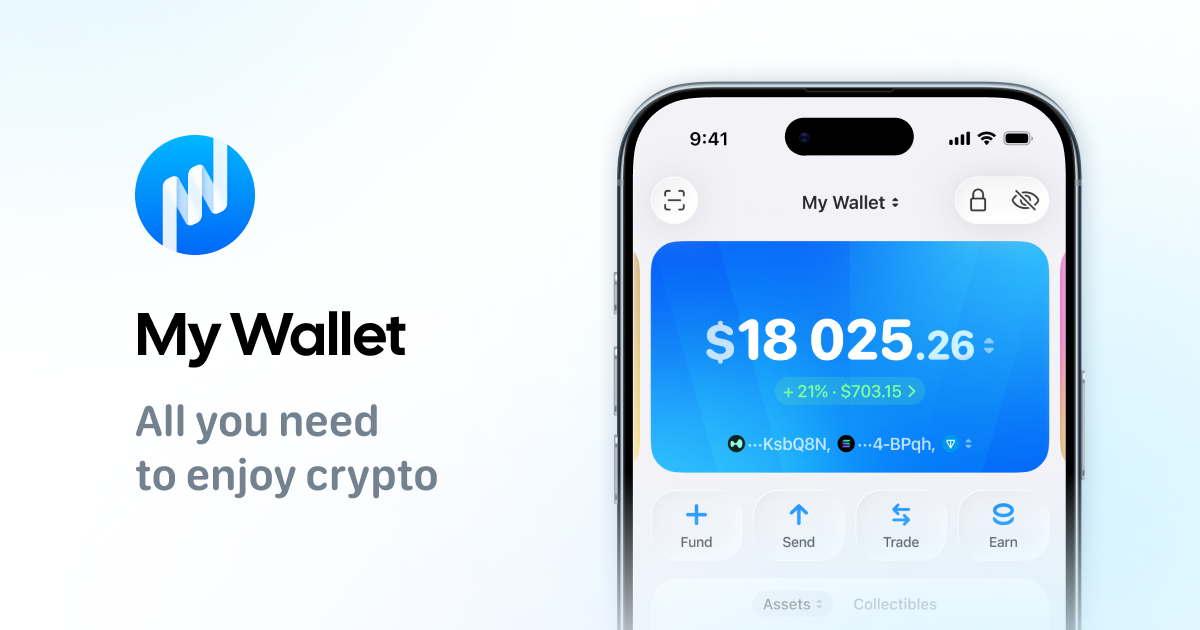
Download My Wallet to hold stablecoins next to the rest of your crypto in one self-custody app. You hold the keys.
FAQ
What is a stablecoin in simple terms?
A stablecoin is a crypto token that aims to keep a steady price, usually $1. It lets you move dollar-linked value on a blockchain without the price swings of most other coins.
Can a stablecoin lose its value?
Yes. A stablecoin can lose its peg if its reserves, collateral, or code come under doubt or stress. Some recover and some do not. Always check the issuer's reports.
Is USDT or USDC better?
It depends on what you need. Both aim to hold $1. They differ by issuer, reporting, and where they are accepted, so match the token and network to your recipient.
What happens if I send a stablecoin on the wrong network?
The funds can be lost or very hard to recover. Always confirm the network before you send, and start with a small test.
Helpful guides
- What is USDT? Why do people use it?
- What cryptocurrencies are supported in My Wallet?
- How to make a cross-chain swap?