
A non-custodial wallet is a crypto wallet where you control the private keys and seed phrase. No company can move your funds without your approval—and no company can recover your wallet if you lose your backup.
Quick answer
Non-custodial = you hold the keys. The wallet provider builds the app; you hold the seed phrase. This is the standard setup for self-custody and the model My Wallet uses by default.
Custodial vs non-custodial
Custodial
- Key control: Platform
- Recovery if password lost: Often possible via support
- Counterparty risk: Higher (funds on platform)
- Typical use: Exchange trading
Non-custodial
- Key control: You
- Recovery if password lost: Only via seed phrase
- Counterparty risk: Lower (funds on-chain under your keys)
- Typical use: Holding, transfers, DeFi, multichain
How non-custodial wallets protect (and limit) you
You gain:
- Full control over sends, swaps, staking, and dapp connections
- No platform freeze on your on-chain assets
- Portability: import the same seed into another compatible wallet
- Sub-wallets in My Wallet for separating everyday and savings balances (guide)
You take responsibility for:
- Writing down and securing your seed phrase offline
- Verifying addresses and networks before sending
- Ignoring phishing messages that ask for your seed
My Wallet does not store your seed phrase on its servers. Official support (@mysupport) will never ask for it.
Seed phrase: the core of self-custody
When you create a non-custodial wallet, you receive a seed phrase (12 or 24 words; new My Wallet wallets default to 12). This phrase generates your private keys across multiple networks—including Bitcoin, Ethereum, Solana, Hyperliquid, TON, TRON, Arc, BNB, Base, Robinhood, Monad, Arbitrum, Polygon, Avalanche, Dogecoin, Litecoin, Bitcoin Cash, and other networks supported in the app.
Learn more: What is a seed phrase and how to store it
When to choose non-custodial
Choose non-custodial if you:
- Hold crypto for weeks or months, not just minutes
- Use Bitcoin and similar networks, Ethereum dapps, Solana DeFi, Hyperliquid, TON Telegram apps, TRON USDT, or other supported chains
- Want one wallet for multiple networks without switching apps
- Prefer not to depend on an exchange for every transfer
Take control of your keys
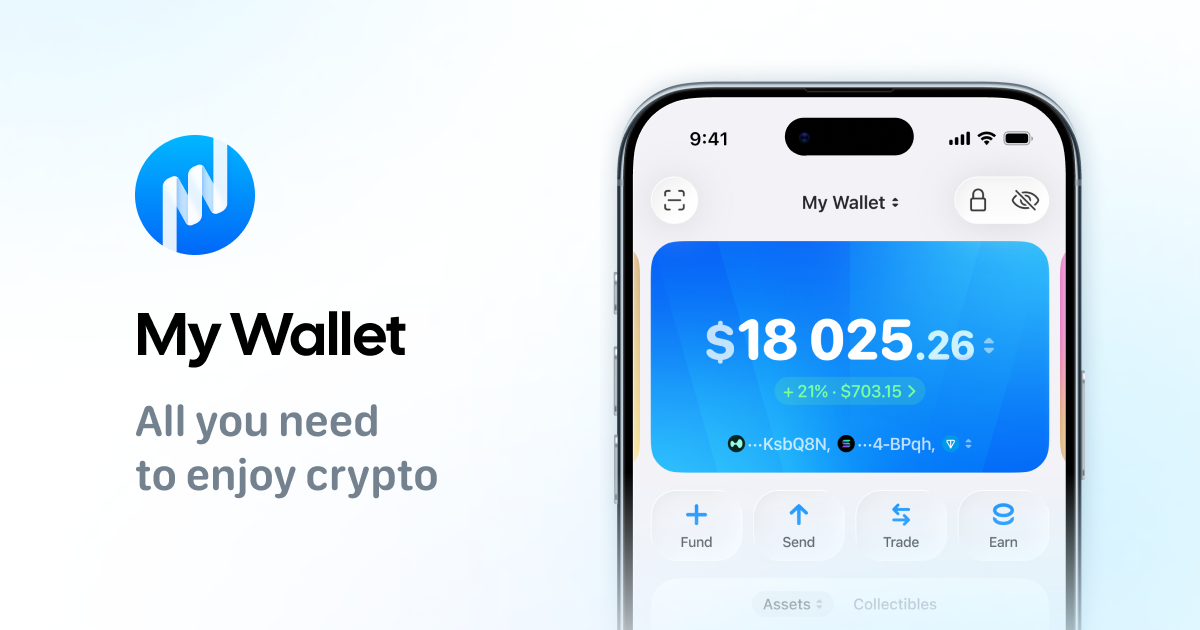
Download My Wallet for self-custody where you hold the keys.
FAQ
Can My Wallet recover my seed phrase?
No. Non-custodial wallets cannot reset or recover your seed phrase. Only your backup can restore access.
Is non-custodial the same as a hardware wallet?
No. Hardware wallets are one type of non-custodial setup where keys stay on a physical device. My Wallet also supports Ledger for importing wallets on supported flows (Ledger import guide).
What if I forget my wallet password?
You can reset the app password if you still have your seed phrase. Import the phrase into a fresh install—your password is local, not your keys.
Are non-custodial wallets safer than exchanges?
For on-chain holding, you remove platform custody risk. Self-custody still requires seed phrase security and phishing awareness—there is no risk-free option.
Can I use non-custodial and an exchange together?
Yes. Many users keep trading balances on an exchange and move longer-term holdings to My Wallet.