
A custodial service holds your private keys for you. A non-custodial wallet lets you hold them yourself.
Quick answer
The key question is who controls the private keys. With a custodial exchange or app, the provider does. With a non-custodial wallet like My Wallet, you do, through your seed phrase. Self-custody gives you direct control, and with it full responsibility for your backup.
Custodial services
- A third party, often an exchange, manages the keys.
- Login with a username and password.
- Identity verification (KYC) is usually required.
- Transactions are screened for anti-money-laundering compliance.
- Easy fiat deposits and withdrawals.
Non-custodial wallets
- You hold the keys through a 12- or 24-word seed phrase.
- No identity verification needed to use the wallet.
- No intermediary between you and the blockchain.
- Fiat options can be more limited.
Trade-offs
- Control: custodial means the provider can restrict access; non-custodial means funds move only with your keys, so keep them private.
- Recovery: custodial services can reset a password; in a non-custodial wallet, only your seed phrase restores access.
- Privacy: custodial usually needs KYC; non-custodial wallets don't.
When a custodial exchange makes sense
- Trading frequently on one platform.
- Converting between crypto and fiat.
- Short-term holding while you learn.
When a non-custodial wallet makes sense
- Holding assets long term.
- Using dapps, staking, or swaps directly on-chain.
- Holding assets on several networks in one place.
Moving from an exchange to My Wallet
- Open Receive in My Wallet and pick the right network.
- Copy the address into the exchange withdrawal form.
- Send a small test amount first.
- Check the transaction with its TXID.
Moving from My Wallet to an exchange
- Check whether the exchange needs a memo/tag. Without it, a deposit may not be credited automatically.
- Match the network the exchange shows for that deposit address.
Where My Wallet fits
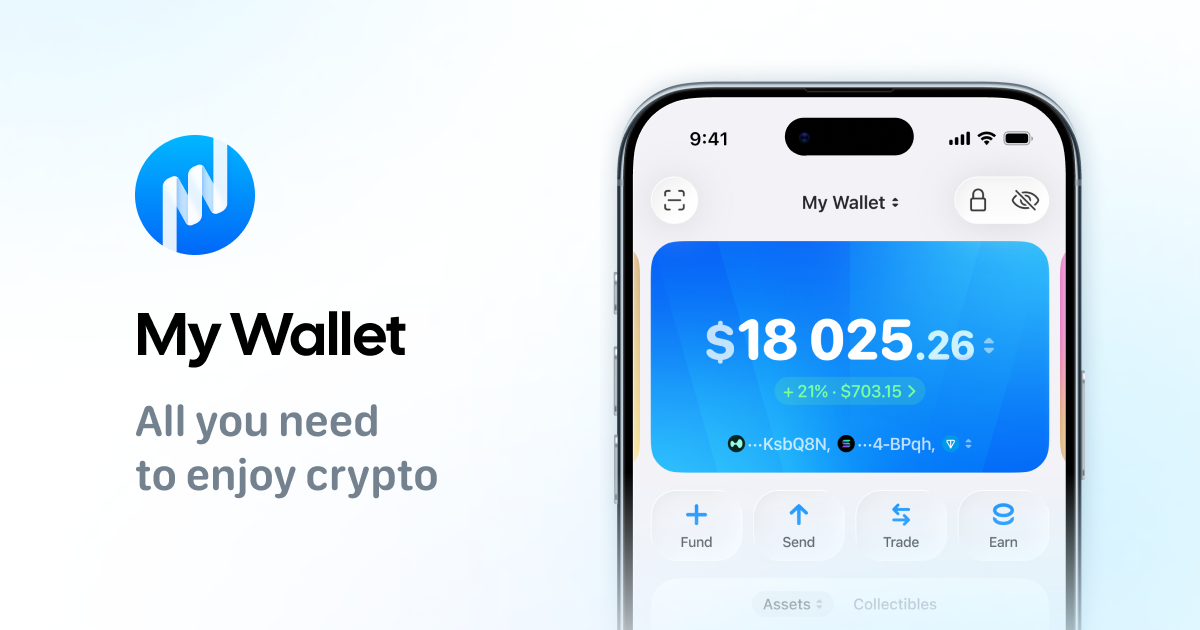
My Wallet is non-custodial. It doesn't store a copy of your seed phrase and can't restore access if you lose it. It supports 19 networks (full list) and includes card buying and selling through MoonPay where available.
Start with a secure wallet
Download My Wallet to explore crypto with self-custody—you hold the keys.
FAQ
Is an exchange account a wallet?
It works like a custodial wallet. The exchange holds the keys.
Can I use both?
Yes. Many people keep trading funds on an exchange and long-term holdings in a non-custodial wallet.
Do I need KYC for My Wallet?
No. KYC isn't needed to use the wallet. Card purchases through a provider may require it.
What if I lose my seed phrase?
In a non-custodial wallet, nobody can restore access for you. Back it up offline.